

Quick answer: Amazon KDP (Kindle Direct Publishing) lets you publish physical and digital books without any upfront costs, and earn royalties on them of up to 70%. You can use it to build a genuine passive income stream, without needing to be a professional author.
I’ve been publishing books on Amazon KDP since 2019, experimenting with everything from low-content puzzle books to full-length novels. In that time I’ve slowly learned what works, what doesn’t work, and what is takes to get a book from zero dollars to generating income monthly. This guide covers everything you need to know.
What Is Amazon KDP?
Amazon KDP (Kindle Direct Publishing) is Amazon’s self-publishing platform that’s open to everyone. You can publish and sell your books directly on Amazon.com without needing a traditional publisher and, most importantly, without any upfront printing costs.
You upload your files, set a price, and Amazon handles everything else, which includes printing, shipping, customer service, and your payments. You earn a royalty on every sale. For print books, Amazon prints them as they’re purchased, so there’s no inventory sitting in a warehouse where you’ll need to pay for storage space – as it is with normal Amazon stock.
Types of Books You Can Publish on Amazon KDP
Let’s take a quick look at the types of books that are allowed on KDP:
1. Full-Content Books (Novels, Non-Fiction, Guides)
These are traditional books that you’d find in any bookstore: novels, memoirs, self-help books, how-to guides, and textbooks. They require the most effort to produce but can also make you the most money. You can write these yourself or use AI tools to assist you (more on this below).
2. Low-Content Books
Low-content books have very little text and most of the pages are identical – things like journals, planners, notebooks, and activity books. These sell well because they can help to fill a hole that many bookstores do not cater for. The best way to make money with these types of books is to create ones that cater for a very specific hobbies that no one else creates books for.
3. Puzzle Books (The Best Entry Point for Beginners)
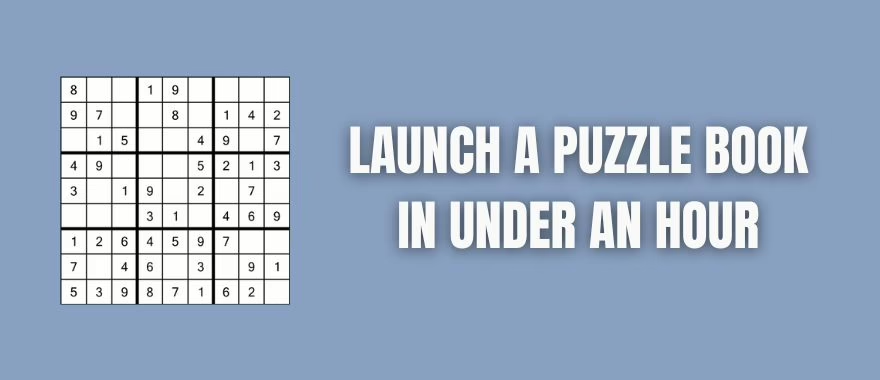
Puzzle books – word searches, sudoku, crosswords, mazes, cryptograms, etc. are always great sellers, especially around Christmas time. You don’t need to write any content and puzzle generators can create all the content you’ll need to create hundreds of books. You simply need to put in the time to create high-quality books with great covers. Read more in our guide: Why Puzzle Books Are the Best Low-Content Products to Sell on Amazon KDP.
Why Use Amazon KDP
Despite being around since 2007, KDP is still one of the easiest ways to make money online. and unlike Merch By Amazon, you don’t need to apply to be accepted. But this could change one day.
Here’s what makes KDP so great:
- Zero upfront cost: Publishing is completely free. You only pay a small cut when a book sells (Amazon deducts print costs from your royalties).
- Global reach: Your books are available on Amazon marketplaces all around the world in the US, UK, Canada, Australia, Germany, Japan, and more.
- Passive royalties: Once a book is published, it can keep earning you money indefinitely with zero extra work.
- Fast publishing: Books on Amazon are usually accpeted in as little as 24-72 hours.
- No experience required: You don’t need to be a professional writer, designer, or marketer to get started.
How to Get Started on Amazon KDP: Step-by-Step
Step 1: Create Your KDP Account
Go to kdp.amazon.com and sign in with your existing Amazon account (or create one). You’ll need to fill in your tax information and your banking details.
Step 2: Choose Your Book Type and Niche
This is the most important step. You need to work out what you want to write about. It’s important to find a niche that has lower competition. If you want your books to be noticed, regardless of whether it’s a puzzle book or a novel, you’ll want it to be unique to everything else out there.
For a full list of niche ideas, see our article: 40 Low-Content Book Ideas to Publish on KDP.
Step 3: Create Your Book Interior
Your interior is the inside pages of your book. For puzzle books, you’ll use a puzzle generator. For low-content books, you’ll use templates or create your own in Canva. For full-content books, you’ll format your manuscript using tools like Microsoft Word, Scrivener, or Atticus.
Key tools at this stage:
- Puzzle generators: See our guide to the best free puzzle generators for KDP.
- Book formatting: See our best free book formatting tools.
- KDP templates: See our free KDP interior templates.
Amazon’s required file format for book interiors is PDF. Your finished interior has to match KDP’s trim size specifications exactly. You can download the full spec sheet from Amazon’s KDP formatting guidelines.
Step 4: Design Your Cover
Your cover is what’s going to bring in customers. It’s the first thing they’ll see while scrolling through Amazon’s marketplace. It has to be eye-catching, and look professional compared to the other books you’re competing with.
You can use KDP’s built-in Cover Creator (free, limited), Canva (free tier available), or tools like Book Brush. For a full breakdown, see our best free book cover tools and where to find free book cover photos.
Step 5: Keyword Research
Before you create your title or fill your description and keywords in Amazon KDP, you need to do some keyword research. The keywords you choose determines whether anyone will ever find your book or not. See the full section below for details.
Step 6: Publish Your Book
Log into KDP, click “Create,” and fill in your book details: title, subtitle, description, keywords (7 keyword phrases), categories (2 categories), and price. Upload your interior PDF and cover PDF. Finally, submit it for review. Amazon typically approves books in 24-72 hours.
Keyword Research: The Most Important Step
Most new KDP publishers either don’t know or care about doing keyword research. Their books site in a pile of millions of other books and don’t ever come up in search results. Your keywords and categories directly determine where Amazon will show your book in the search results.
How KDP Keywords Work
Amazon gives you 7 keyword phrase slots (up to 50 characters each). You fill them with keywords that are related to your book, that customers might search for and that are not being used as much by other sellers. These are phrases like “large print word search for seniors” or “sudoku easy for beginners.”
Tools for KDP Keyword Research
The gold standard for keyword research is Publisher Rocket, it shows the exact search volume and competition data for all Amazon book searches. We have compared it in detail against alternatives in our article: Helium 10 vs Publisher Rocket vs Book Beam vs Bookbolt.
For free options, see our guide to free KDP keyword research tools.
For puzzle-book-specific research, check out: Keyword Research for Puzzle Book Success on Amazon KDP.
Best Cover Design
Making a cover that looks professional immediately tells customers that your books are worth the price. Here are some quick pointers of what you covers should cover:
- Be readable even as a small thumbnail (around 160×256 pixels)
- Clearly tell customers what you book is about
- Look as good or better than bestsellers in your category
- Use high-contrast text and imagery
AI-generated images are allowed on KDP and are a cheap and easy way to make great-looking covers for your books.. See our tutorial on using AI images for KDP covers. For a full comparison of AI art tools, see our Stable Diffusion vs Midjourney vs DALL-E comparison.
Pricing and Royalties Explained
Royalty Rates
- eBooks: 35% royalty for books priced below $2.99 or above $9.99; 70% royalty for books priced between $2.99 and $9.99 (on select marketplaces).
- Paperbacks: 60% royalty minus the printing cost. For a 100-page book in the US, printing costs approximately $2.15. So a book priced at $6.99 earns roughly $2.04 per sale.
- Hardcovers: 60% royalty minus the printing cost (higher than paperback).
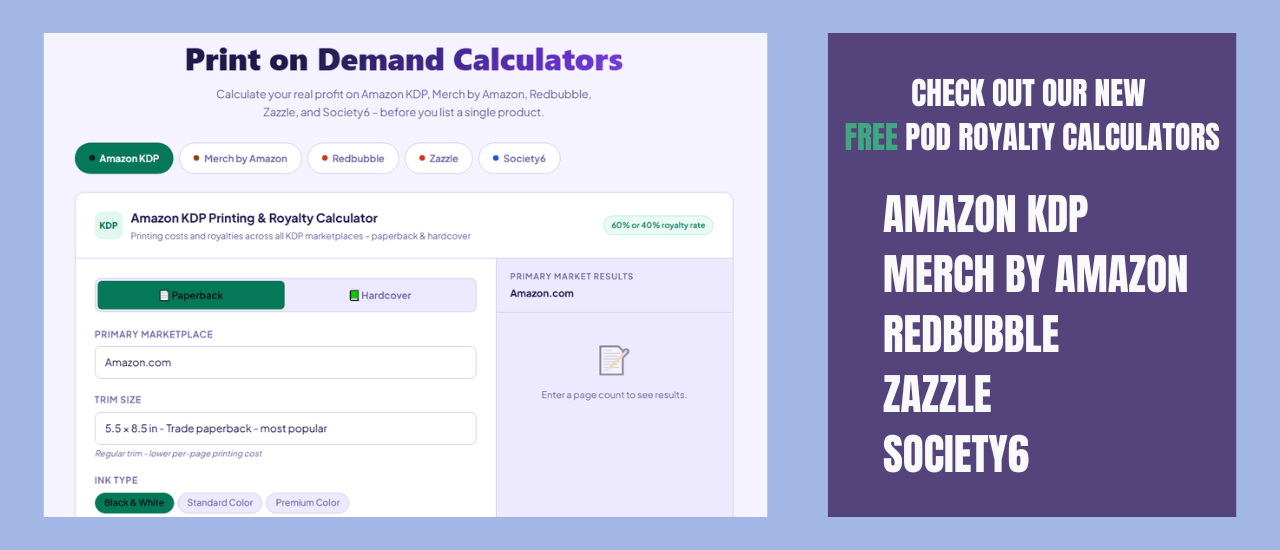
You can use our Amazon KDP Calculator to quickly check how much money you can make with KDP.
Pricing Strategy
For puzzle books and low-content books, pricing your books between $5.99 and $9.99 is usually your best bet. Look at what others in your niche are pricing at and try to slighly undercut them to get your first few sales and build some reviews.
How to Market Your KDP Books
Amazon will show you books to people that search for them, but they can get buried in a sea of other books if you don’t try to get some eyes on them yourself. Once momentum hits, and they’re showing at the top of results, you usually don’t need to market your books any longer.
Amazon Ads (AMS)
Amazon’s advertising platform (Amazon Advertising, formerly AMS) lets you run sponsored product ads directly on Amazon. You can start with a small daily budget and use keywords that you’ve collected to help get eyes onto all your books.
Optimise Your Book Description
Your description is also very important in getting your books noticed. Throw in some keywords, but also focus on making your books sound as exciting and interesting as possible.
Build a Series
One of the best and fastest ways to get more sales is to publish a series of related books. A buyer who enjoys your “Easy Sudoku for Seniors Volume 1” is highly likely to buy Volume 2 and 3. Amazon also promotes series books together. See our guide on the easiest way to make more puzzle book sales.
Use Social Media
Pinterest is really good for getting your KDP books noticed. Pins can drive lots of traffic to your Amazon listing. See our guide on how to promote your online business on social media.
How Much Can You Realistically Make?
This is the main question that everyone asks, and the honest answer is:
It depends. Here’s a realistic breakdown:
- Months 1–3 (building phase): Most publishers earn $0–$50/month while they learn new skills and publish their first few books.
- Month 6–12 (momentum phase): Publishers with 10–30 books and good keyword research typically earn $200–$1,000/month.
- Year 2+ (scale phase): Publishers with 50+ well-researched books can earn $2,000–$10,000+/month in royalties.
Remember volume is important. This is a numbers game. A single book might earn $15–$50/month. A catalogue of 100 books earning $15–$50 each generates $1,500–$5,000/month passively.
For more details on passive income, read our guide: How to Earn Passive Income with Puzzle Books.
Frequently Asked Questions
Is Amazon KDP free to use?
Yes, publishing on KDP is completely free to publish your books on. Amazon deducts their printing costs from royalties on physical book sales. There are no upfront fees, monthly fees, or per-book fees.
Do I need to be a professional writer to publish on KDP?
No. Puzzle books, journals, planners, and other low-content books require no writing at all. For novels, writing skills definitely help, but tools like AI writing assistants can help even the weakest writers to create good books.
How long does it take to start earning money on KDP?
Amazon pays our their royalties 60 days after the end of the month in which those sales occurred. So if you make your first sale in January, you will only receive your first payment in late March. Realistically, expect 3-6 months before you start seeing a monthly income.
Can I publish KDP books from outside the US?
Yes. KDP is available worldwide. You’ll receive your royalty payments in your local currency or USD via bank transfer.
How many books do I need to make $1,000/month?
This depends heavily on your niche, keywords, and how good your marketing is. As a rough guideline, if each book earns $15-$30/month, you’d need 33-67 books. You’ll definitely need strong keyword research and a very targeted niche to improve your per-book earnings.
What’s the difference between KDP and Merch by Amazon?
KDP is for books (physical and digital). Merch by Amazon is for clothing and other merchandise (T-shirts, hoodies, mugs, etc.). Merch By Amazon requires you to apply and wait a few months to be accepted or rejected. Both are print-on-demand platforms and both have no upfront costs. Read our guide on starting a Merch by Amazon business if you’re interested in both.
Ready to start? Then it’s time to start looking for a niche. If you’re a beginner, we strongly recommend starting with puzzle books -read our full case for why in Why Puzzle Books Are the Best Low-Content Products to Sell on Amazon KDP.
Last Updated on May 22, 2026

With more than fifteen years of blogging experience, I have contributed to numerous respected websites and publications. I am also the author of multiple books that have sold thousands of copies and currently lead a successful digital sales business. Writing remains my core passion, and I am dedicated to creating meaningful stories and insights that resonate deeply with readers.